I have helped students through hundreds of dissertations and papers. Here are the 9 mistakes that cost people the most marks (and how to fix each one)
Academic writing guide
9 mistakes that cost students the most marks
How to spot each one in your own draft and fix it, with templates, a 16-week dissertation plan and a rubric self-check you can use today.
Most lost marks have little to do with intelligence or effort. They come from process: the order you work in, how you frame the question, and what you check before you hand in.
Across assignments, research papers, journal articles and dissertations, the same nine mistakes appear again and again. Each section below shows what the mistake looks like, why markers penalise it, and a concrete fix you can apply to your current draft. Everything here is about building your own work and your own skills, so the grade you earn is one you can defend in a viva or a follow-up question.
Skim the headings, then spend your time on the two or three that sound most like you.
Mistake 1 of 9
Starting with a topic instead of a question
A topic gives you somewhere to read. A question gives you something to prove. Without a question, projects drift: you collect interesting material, then discover at the end that it does not add up to an argument.
Social media and mental health
How does daily Instagram use affect anxiety in 18 to 24 year old university students?
Keep narrowing until the question names a variable, a group and a context.
The fix
- Fill in the template: How does (or to what extent does) [factor] affect [outcome] in [group or context]?
- Run the one-sentence test. If you cannot answer it in a sentence, however tentatively, it is still too broad.
- Check it is answerable with the time, data and sources you actually have.
- Ask whether a reasonable person could disagree with your answer. If not, it is a fact, not an argument.
Quick test: a question that starts with “What is” often yields description. Questions that start with “How”, “Why” or “To what extent” push you towards analysis.
Mistake 2 of 9
Writing the introduction first
An introduction promises an argument. Until you have written the argument, you are guessing what you promised, and guesses show up as vague openings and a roadmap paragraph that does not match the chapters. Most experienced writers draft the introduction last and polish it after the conclusion.
Chips run in the order the reader meets them. The number shows when to write each one.
Reader starts hereReader finishes here
The fix
- Write a one-paragraph “working introduction” in week one to keep yourself pointed in the right direction, then replace it at the end.
- When the draft is complete, write the introduction in this order: context, problem, gap, your question, your approach, a short map of the chapters.
- Reread the conclusion and the introduction together. They should answer each other.
Mistake 3 of 9
Describing instead of arguing
Markers reward analysis and critical evaluation. A paragraph that summarises what sources say earns pass-level marks at best. Higher marks come from showing what the evidence means and why it matters for your question.
One invented example, climbing from description to argument. Aim for the top rung in every paragraph.
Smith (2020) surveyed 300 students about their phone use.
The study found that heavier night-time use was linked to shorter sleep.
This matters because sleep loss is the pathway most earlier studies on anxiety leave out.
Interventions should target night-time use specifically rather than total screen hours.
The fix
- After every paragraph, write “So what?” in the margin. If your next sentence would be a shrug, the paragraph is description.
- Make claims in your own voice at the start of a paragraph, then use sources as evidence for them. Sources should support you, not narrate for you.
- Use evaluative verbs: suggests, fails to account for, overlooks, strengthens, contradicts.
- Compare. Where two sources disagree, say why, and say which you find more convincing.
Mistake 4 of 9
A literature review that reads like a book report
“Smith says this. Jones says that. Lee says something else.” That structure lists sources but does not use them. A good review is organised by ideas, shows where scholars agree and disagree, and ends by pointing to the gap your project fills.
By source (weak)
- Paragraph on Smith (2020)
- Paragraph on Jones (2018)
- Paragraph on Lee (2021)
- …seven more paragraphs
- No link to your question
By theme (strong)
- Theme 1: how anxiety is measured (four sources compared)
- Theme 2: sleep as a possible pathway (three sources, one dissenting)
- Theme 3: student populations (two sources, both small samples)
- Gap: nobody studies night-time use in this group
The fix
- Build a simple matrix in a spreadsheet: sources down the side, themes across the top. Fill each cell with a few words.
- Each paragraph should be about an idea, citing two to four sources.
- Finish the chapter with a gap statement. A reliable pattern: “Although X has been studied extensively (A, B, C), little is known about Y in context Z. This study addresses that gap by…”
- Cut anything that does not help justify your question or your method.
Mistake 5 of 9
Weak signposting
Your reader is a marker with a stack of scripts. If they have to guess where an argument is going, they will guess against you. Signposting tells them where they are, why it matters and what comes next.
Use it as a default structure, then vary it once the habit is solid.
Section-level signposting
- Open each section with one sentence on what it will do: “This section compares three measures of anxiety to justify the choice made in Chapter 3.”
- Close each section with one sentence linking back to your thesis.
- Use headings that say something. “Findings” is a label. “Night-time use predicted anxiety more strongly than total hours” is a finding.
Mistake 6 of 9
Citing as an afterthought
Rebuilding a reference list the night before the deadline is where lost page numbers, mismatched years and accidental plagiarism come from. Referencing costs marks directly and puts your academic integrity record at risk.
The fix
- Use a reference manager from day one. Zotero is free and works with Word and Google Docs. Mendeley is a common alternative.
- Capture the full details when you read. Author, year, title, journal, volume, pages and DOI. Note page numbers for anything you might quote.
- Choose the style early. APA 7, Harvard, MLA, Chicago and Vancouver all differ. Check your department handbook rather than guessing.
- Run a two-way check at the end. Every in-text citation needs an entry in the reference list, and every entry must be cited somewhere in the text.
Paraphrasing is more than swapping words
Heavy night-time phone use was strongly connected with decreased sleep duration in the sample.
Students who used their phones late at night slept less, and the effect held across the whole sample (Smith, 2020).
To paraphrase properly, read the passage, close the source, explain the idea from memory in your own structure, then check you have not drifted from the meaning. Cite either way.
Mistake 7 of 9
Ignoring the marking rubric
The rubric is the closest thing to the exam paper you get in advance. Each criterion is a place where marks are won or lost, and the weighting tells you where to spend your time. Print it, pin it beside your screen and check your draft against it line by line before you submit.
Score your own draft from 1 (weak) to 4 (strong). The scores below are examples. Change them to match your work.
| Criterion | What a 4 looks like | Your score |
|---|---|---|
| Argument | A clear thesis that every section supports | |
| Evidence | Relevant, recent, well-chosen sources | |
| Structure | Logical flow with signposting between sections | |
| Criticality | Sources compared and evaluated, limitations acknowledged | |
| Referencing | Consistent style, every source matched both ways | |
| Presentation | Clean formatting, correct grammar, within word count |
Average 3.0 out of 4. Weakest: Structure, Criticality. Start your next editing pass there.
The fix
- Copy each criterion into a checklist and tick it only when you can point to the paragraph that satisfies it.
- Compare your draft against the top band’s wording, not just the pass band.
- Ask your tutor for a marked example if the department shares one. Seeing a real 70+ paper changes how you write.
Mistake 8 of 9
Editing while you write
Polishing sentences you may delete tomorrow is the most common way to lose a week. Writing and editing use different parts of your attention. Do them separately: write badly and quickly first, then edit in passes that zoom in from the whole document to single words.
1. Structure
Reverse outline. Move, merge or cut sections. Does the order serve the argument?
2. Argument
Is every claim supported? Any gaps in logic? Does each section answer the question?
3. Clarity
One idea per paragraph. Shorten long sentences. Cut filler like “very” and “in order to”.
4. Proofread
Spelling, grammar, formatting, references. Read it aloud, or change the font to see it fresh.
Mistake 9 of 9
Submitting without outside feedback
After weeks on one document, you read what you meant to write, not what is on the page. A second reader sees the missing step in your logic immediately. Even one round of feedback before submission usually improves a grade more than another day of solo polishing.
Who can give useful feedback
- Your supervisor or tutor. Use office hours and bring specific questions, not just “is this OK?”
- The university writing centre. Most offer free appointments and know the local marking culture.
- A peer. Swap sections with a classmate. Reading someone else’s work also sharpens your own.
- A professional editor or tutor. Useful for language, structure and clarity, as long as the ideas and writing remain yours.
Three questions that get better answers
- “In one sentence, what do you think my argument is?” (If they are wrong, your thesis is unclear.)
- “Where did you get lost or lose interest?”
- “Which paragraph is weakest, and why?”
Handling what comes back
Sort every comment into three piles: fix now, fix if time allows, and disagree. For the last pile, you do not have to accept the advice, but write a one-line reason for each so you are choosing rather than ignoring.
The 16-week dissertation plan
Mistakes 1 to 9 are easiest to avoid when the schedule leaves room for them. This plan suits a typical undergraduate or master’s dissertation. Compress or stretch it to match your deadline.
Referencing runs the whole way through, which is why it never becomes a last-night panic.
- Weeks 1 to 2: finalise the question, agree the proposal with your supervisor, set up Zotero and a folder system.
- Weeks 3 to 6: read, build the theme matrix, draft the literature review and a working introduction.
- Weeks 7 to 9: finalise methods, get any ethics approval, collect data.
- Weeks 10 to 13: analyse data and write up findings. Return to the literature review and update it based on what you found.
- Weeks 14 to 15: write the discussion and conclusion, then rewrite the introduction and write the abstract.
- Week 16: the four editing passes, a feedback round, then a final check against the rubric.
A rough guide only. Always check your department’s guidance and the marking rubric.
- Introduction800 words
- Literature review2,800 words
- Methods1,400 words
- Results2,400 words
- Discussion3,400 words
- Conclusion1,200 words
Final submission checklist
Tick these off before you upload. Your progress is saved in this browser.
Common questions
How many sources should a literature review have?
There is no universal number. For an undergraduate dissertation, 30 to 60 well-chosen sources is common, and for a master’s it is often more. Quality and relevance matter more than count. Check the guidance for your programme.
I am out of time. Which mistake should I fix first?
Fix the argument first (mistakes 1, 3 and 5), because structure and criticality carry the most marks. Next, do the referencing check and a single proofreading pass. Polishing sentences comes last.
Is it OK to use a tutor or editor?
Feedback on structure, clarity and language is a normal part of learning, and universities encourage it through writing centres. What matters is that the ideas, analysis and writing remain yours. Check your institution’s academic integrity policy for what help is allowed.
How do I stop procrastinating on the first draft?
Set a timer for 25 minutes and write without deleting anything. Start with the section you find easiest, not page one. A messy draft you can edit beats a perfect paragraph you never write.
Do these tips work for journal articles as well as dissertations?
Yes. Journal articles are shorter, so the question, the gap and the argument need to be even tighter. Check the target journal’s author guidelines for structure and word limits before you start.
Want more study guides and writing support?
We publish practical guides for students working on assignments, research papers, dissertations and journal articles. Visit our site for more.
Visit meet2share.comPublished by Educare Centre. This guide is general study advice. Always follow your institution’s own rules on referencing, word counts and academic integrity.
How to Find Authentic, Non‑AI Dissertation Writing Services in 2026
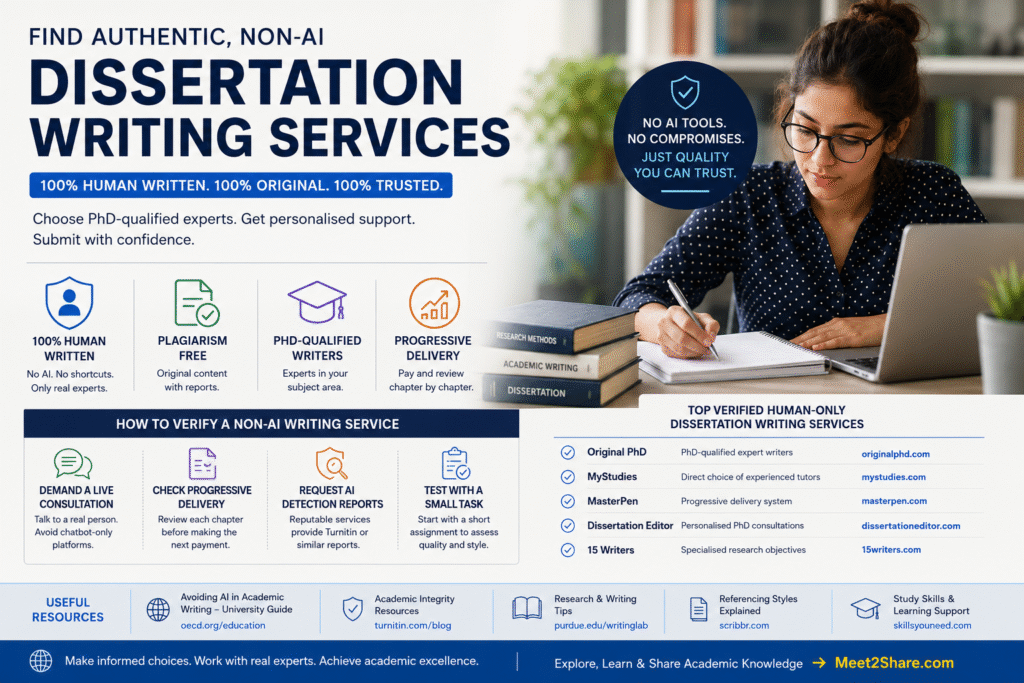
In an era where AI-generated academic content is becoming increasingly common, many students are now actively searching for authentic dissertation writing support delivered by real human researchers. Whether you are pursuing a Master’s degree or a PhD, working with experienced academic experts can make a significant difference in the quality, originality, and credibility of your dissertation.
The challenge, however, is identifying which dissertation writing platforms genuinely provide human-written work and which rely heavily on AI-generated content. This guide explores how students can identify trustworthy dissertation support services, what signs to look for, and which features separate credible academic assistance providers from low-quality alternatives.
Why Students Prefer Human Dissertation Writers
A dissertation is one of the most important academic projects a student will complete. Unlike short assignments, dissertations require:
- Advanced critical thinking
- Original research
- Theoretical analysis
- Proper academic methodology
- Consistent academic tone
- Accurate referencing
- Subject expertise
AI tools may assist with brainstorming or editing, but they often struggle with originality, contextual understanding, nuanced arguments, and discipline-specific research standards. As a result, many students now prefer dissertation support services that guarantee genuine human-written academic work.
Professional dissertation consultants also provide something AI cannot fully replicate: mentorship, academic experience, and personalized guidance tailored to a student’s exact research topic.
Verified Human‑Only Dissertation Writing Services
Below are some dissertation support platforms that publicly emphasize human-written academic assistance and personalized research support.
| Service | Primary Feature | Key Assurance |
|---|---|---|
| Original PhD | PhD-qualified expert writers | 100% AI and plagiarism-free content |
| MyStudies | Direct choice of experienced tutors | “No plagiarism, no AI” guarantee |
| MasterPen | Progressive delivery system | Human writers with PhD/Master’s qualifications |
| Dissertation Editor | Personalized PhD consultations | Human-powered academic assistance |
| 15 Writers | Specialized research objectives | Orders completed by human researchers |
Students should independently verify any service before making payments or sharing sensitive academic information. Conducting proper background checks and communicating directly with service providers can significantly reduce academic and financial risks.
How to Verify a Dissertation Service is Truly Human-Written
1. Demand a Live Consultation
One of the easiest ways to identify a genuine dissertation support provider is through direct communication. Avoid services that rely entirely on automated chatbots.
Reliable academic consultation platforms usually provide:
- WhatsApp consultations
- Live chat with human representatives
- Email communication with assigned writers
- Zoom or Google Meet consultations
Direct communication allows students to evaluate the expertise, professionalism, and responsiveness of the academic consultant before committing to a project.
For example, many students searching for research guidance also use academic collaboration platforms such as Meet2Share Academic Network to connect with educational resources, academic discussions, and scholarly opportunities online. Students interested in broader educational discussions can also explore academic-related content through Meet2Share Blog and Learning Resources, where educational insights and learning opportunities are regularly shared.
2. Look for Progressive Delivery Systems
A trustworthy dissertation service should never disappear until the final deadline. Instead, credible services usually deliver work progressively.
This means students receive:
- Proposal chapters first
- Literature review drafts
- Methodology sections separately
- Regular updates and revisions
- Supervisor feedback integration
Progressive delivery systems help students:
- Monitor writing quality
- Verify consistency in writing style
- Reduce academic risks
- Ensure originality throughout the project
Many modern educational support communities now encourage collaborative learning approaches through academic networking websites such as Meet2Share Academic Community where students exchange educational opportunities, learning resources, and scholarly insights. Students searching for educational marketplaces, student resources, and collaborative academic opportunities may also benefit from browsing the urlMeet2Share Marketplace Directory for useful academic and technology-related listings.
3. Request AI Detection and Plagiarism Reports
With universities increasingly using AI detection software, students should ask dissertation support providers for:
- Turnitin similarity reports
- AI detection reports
- Originality certificates
- Referencing verification
A professional academic support provider should be transparent about originality standards and willing to explain their writing process.
Students researching dissertation writing trends, educational technology, and academic support systems often browse learning-focused platforms like Meet2Share Global Learning Hub for additional educational guidance and peer collaboration opportunities. Those interested in technology tools, digital learning resources, and educational gadgets can also explore sections such as Meet2Share Technology and Devices Listings for practical academic and productivity-related resources.
4. Test the Service with a Small Task First
Before committing to a full dissertation project, students should start with a smaller paid task such as:
- A discussion post
- Literature review summary
- Annotated bibliography
- Research proposal section
- Reflection paper
This helps students evaluate:
- Writing quality
- Turnaround speed
- Referencing accuracy
- Communication standards
- Subject expertise
Testing smaller tasks first significantly reduces the risks associated with online academic services.
Warning Signs of Low-Quality or AI-Driven Dissertation Services
Students should be cautious of dissertation services that:
- Promise unrealistic delivery times
- Offer extremely cheap pricing
- Refuse live consultations
- Have generic or duplicated website content
- Avoid showing writer qualifications
- Lack revision policies
- Use only automated customer support
- Cannot explain research methodology clearly
Low-quality services frequently rely on AI-generated drafts, recycled content, or poorly supervised outsourced writers with limited academic expertise. This can negatively affect originality, research depth, and overall dissertation quality.
The Growing Demand for Ethical Academic Support
The global academic environment is changing rapidly. Students today are not simply looking for “essay writing services.” Instead, many seek:
- Academic mentorship
- Research guidance
- Dissertation coaching
- Editing support
- Methodology assistance
- Referencing help
- Statistical consultation
As a result, educational networking communities are becoming increasingly important.
Websites such as Meet2Share Educational Platform are helping students discover learning opportunities, collaborate academically, and connect with broader educational discussions beyond traditional classroom environments. Beyond academic networking, students can also explore entrepreneurial, technology, and student-support listings through sections like Meet2Share Business and Services Hub which provides broader educational and business-oriented exposure.
Final Thoughts
Finding an authentic, human-written dissertation support service requires careful evaluation. Students should prioritize transparency, direct communication, progressive delivery systems, and originality guarantees.
The safest approach is to combine professional academic support with active personal involvement in the research process. This not only improves dissertation quality but also strengthens the student’s understanding of their own research topic.
In addition to evaluating dissertation services, students can benefit from joining broader educational and academic networking communities that promote collaboration, research engagement, and knowledge sharing.
Platforms like Meet2Share Global Academic Networkcontinue to grow as spaces where students, researchers, and professionals connect through education, opportunities, and shared academic interests. Readers looking for broader student opportunities, educational discussions, and digital networking spaces can further explore urlMeet2Share Community Marketplace as part of a growing global academic and professional ecosystem.
Why “Human-Written” Academic Help Matters More Than Ever in 2026
Why “Human-Written” Academic Help Matters More Than Ever in 2026
If you’ve been searching for academic writing help lately, you’ve probably noticed something frustrating:
Everything claims to be human-written…
But much of it still feels generic, scripted, or just slightly “off.”
That gap between promise and reality is exactly why more students in 2026 are rethinking how they get academic support.
🤖 The Problem with AI-Like Writing (Even When It’s Not AI)
AI tools have changed the academic space—but not always for the better.
Students now face:
- Writing that sounds polished but lacks real depth
- Arguments that feel repetitive across different papers
- Work that doesn’t reflect their personal academic voice
Institutions are also adapting. Systems influenced by platforms like Turnitin are becoming more sensitive to patterns that signal non-authentic writing.
So the real question students are asking today is:
👉 “How do I get help that actually sounds like me—and still meets academic standards?”
🎯 What “Human-Written” Should Actually Mean
In 2026, human-written academic help isn’t just about avoiding AI tools.
It’s about:
- Real understanding of your subject
- Writing that matches your level and tone
- The ability to ask questions and refine ideas
In short:
👉 It’s not just about getting work done
👉 It’s about being part of the process
🧠 The Shift: From Outsourcing to Collaboration
A growing number of students are quietly moving away from traditional writing services.
Instead of:
❌ Submitting instructions and waiting for a finished paper
They’re choosing:
✅ Interactive, human-centered support
This allows them to:
- Improve their arguments
- Understand their assignments better
- Produce more authentic work
🌐 A Smarter Way to Approach Academic Help
Rather than relying on one-way services, some students are exploring collaborative academic environments—spaces designed for interaction, not just delivery.
These platforms allow you to:
- Engage with ideas before final submission
- Get feedback that actually improves your thinking
- Develop work that reflects your own voice
If you want to see how this kind of approach works in practice, you can take a closer look here:
👉 https://meet2share.com/
It’s not positioned as a typical “writing service”—and that’s exactly the point. The focus is on supporting your academic process, not replacing it.
💬 Why Academic Communities Are Becoming Essential
Another major shift is happening outside traditional websites.
Students are increasingly relying on peer-driven spaces for:
- Honest advice
- Real academic experiences
- Practical guidance
These conversations often provide more clarity than static service pages.
You can see an example of this kind of ongoing academic discussion and support here:
👉 https://www.facebook.com/meet2shareacademicservices/
These spaces offer something most services don’t:
👉 Real interaction and shared learning
📌 What to Look for Before You Choose Academic Help
Before you commit to any platform or service, ask yourself:
- Does this feel genuinely human?
- Can I interact and ask questions?
- Will this help me improve—not just submit?
- Does it adapt to my subject and level?
If the answer is no, you’re likely dealing with surface-level support.
🚀 Final Thought
In 2026, the difference isn’t just between good and bad academic writing services.
It’s between:
👉 Artificial support
and
👉 Authentic academic growth
Students who are getting the best results aren’t just outsourcing their work.
They’re choosing smarter, more human approaches—ones that help them think better, write better, and actually understand what they’re submitting.
And in the long run, that’s what truly sets them apart.
Is AI Allowed in Academic Writing in 2026? (Avoid Penalties & Get Higher Grades)
Introduction: AI Is Helping Students—But Also Getting Them Penalized
Artificial intelligence is transforming education faster than most universities can regulate it.
Tools like ChatGPT are now used by students worldwide to:
- Brainstorm ideas
- Structure essays
- Generate drafts in seconds
But here’s the reality most students are ignoring:
👉 Many are losing marks—or worse—because they’re using AI incorrectly.
Policies are unclear. Rules vary. And one mistake can cost your grade.
So the real question is:
👉 Is AI allowed in academic writing—or are you risking penalties?
What Universities Actually Allow (2026 Reality)
Most universities do NOT fully ban AI—but they regulate how it’s used.
✅ Allowed Uses of AI in Academic Writing
- Idea generation and brainstorming
- Grammar and editing assistance
- Structuring outlines
- Clarifying complex concepts
❌ What Can Get You Penalized
- Submitting AI-generated content as your own
- Copy-pasting responses without understanding
- Failing to cite or verify AI-supported ideas
👉 Golden Rule:
AI should support your thinking—not replace it.
⚠️ Common Mistakes That Are Costing Students Marks
Most penalties don’t come from using AI—they come from using it wrong.
Here’s what students keep doing:
❌ Copy-pasting AI output directly
❌ Skipping fact-checking
❌ Ignoring referencing rules
❌ Submitting work they don’t understand
👉 The result?
- Plagiarism flags
- Weak arguments
- Low grades
And by the time you realize—it’s already submitted.
🧠 How to Use AI Safely (Step-by-Step Strategy)
Students who get top marks don’t avoid AI—they use it smarter.
Step 1: Use AI for Structure
Generate an outline or idea map
Step 2: Rewrite in Your Own Voice
Never submit raw AI output
Step 3: Add Academic Sources
Use journals, books, and credible references
Step 4: Add Critical Analysis
This is what lecturers actually grade
👉 Pro Tip:
If you can’t explain your essay without AI—you shouldn’t submit it.
😓 Why AI Alone Is Not Enough
Even with AI, students still struggle with:
- Argument development
- Academic tone
- Referencing
- Structure
AI gives you speed…
But not always quality.
And in academic writing, quality is what earns marks.
🚀 The Smarter Way Students Are Getting Better Grades
Instead of guessing, many students now combine AI with expert academic support.
Platforms like Meet2Share help students:
- Refine AI-generated drafts
- Improve structure and clarity
- Meet academic standards
👉 This is the difference between:
- Submitting average work
- Submitting high-grade, polished assignments
🔗 Recommended Resources
To strengthen your research and improve credibility, students often refer to:
- Google Scholar for academic sources
- University AI policy pages (e.g., institutional guidelines)
- Writing support platforms like Meet2Share
👉 These sources improve both quality and credibility in your assignments.
🎯 Final Thoughts: AI Is Not the Problem—Strategy Is
AI is not going away.
But the students getting top grades are not the ones using AI the most—
they’re the ones using it correctly.
👉 The real risk is not AI…
👉 It’s using AI without understanding academic expectations.
⚡ Call to Action
Don’t risk your grades by guessing.
If you want to:
✔ Improve your assignment quality
✔ Avoid AI-related penalties
✔ Submit confidently
👉 Get expert academic support on Meet2Share today.
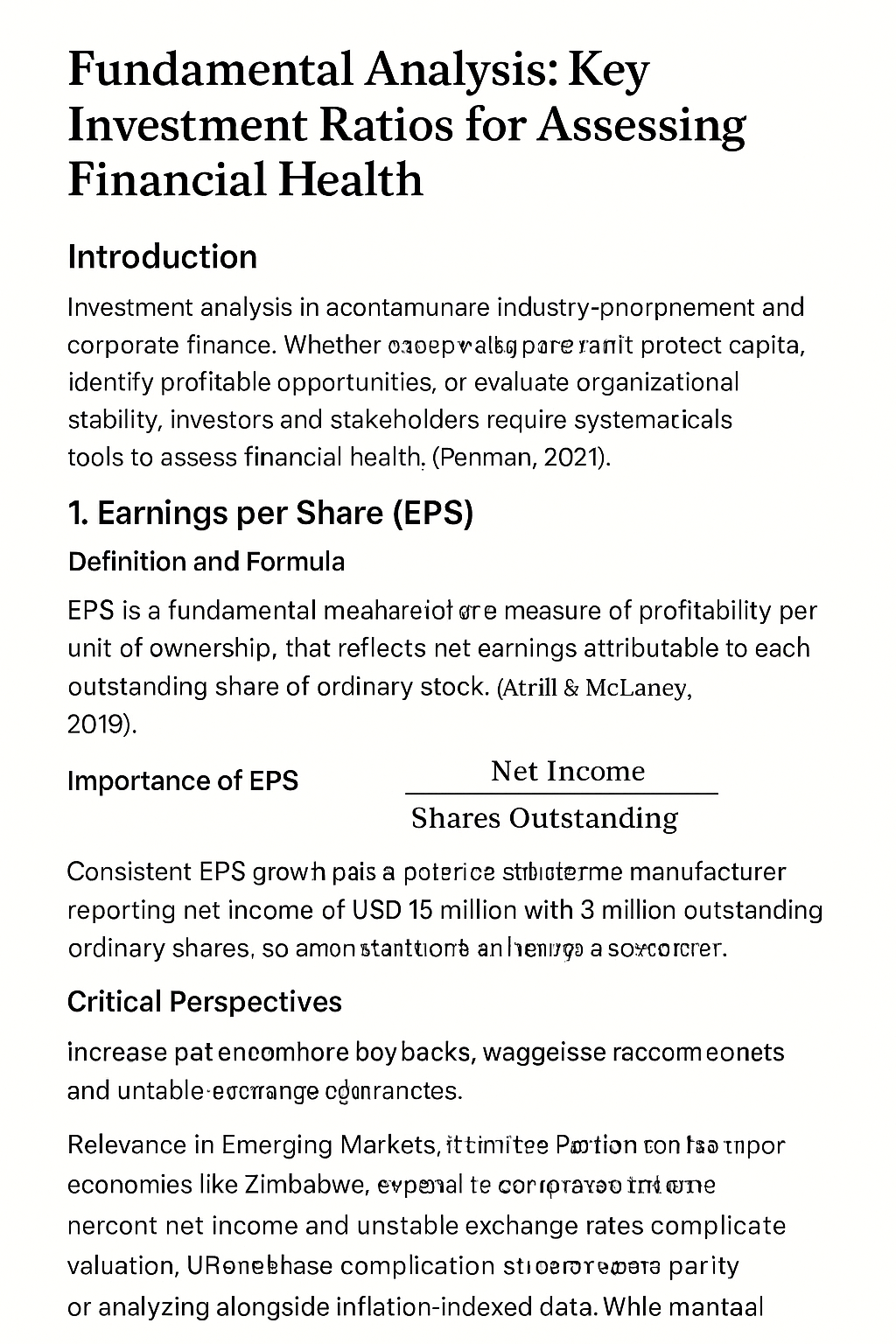
Fundamental Analysis: Key Investment Ratios for Assessing Financial Health
Introduction
Investment analysis lies at the core of both individual wealth management and corporate finance. Whether the objective is to protect capital, identify profitable opportunities, or evaluate organizational stability, investors and stakeholders require systematic tools to assess financial health. One of the most widely used approaches is fundamental analysis, which examines the intrinsic value of a business by interrogating financial statements, operational performance, competitive advantage, and macroeconomic conditions (Penman, 2021). Unlike technical analysis, which primarily focuses on price movements and market psychology, fundamental analysis provides a structured examination of profitability, risk, and long-term sustainability.
At the centre of this framework are financial ratios, which translate complex data into interpretable measures of financial health. Ratios condense volumes of accounting information into standardized metrics that can be compared across time, sectors, and economies (Atrill & McLaney, 2019). They serve as the foundation of decision-making for investors, creditors, regulators, and managers. In volatile and inflation-prone markets such as Zimbabwe, their relevance becomes even more critical, as ratios simplify fluctuating figures into meaningful patterns (Mhlanga, 2020).
This essay discusses five major ratios that are indispensable for assessing organizational financial health:
- Earnings per Share (EPS)
b) Interest Cover Ratio
c) Dividend Payout Ratio
d) Capital Gearing Ratio
e) Dividend Cover
Each ratio is defined, its formula explained, and its interpretation illustrated with practical examples, including cases from emerging markets. The essay also highlights their limitations, relevance in the Zimbabwean context, and insights from recent research (2018–2023). A comparative discussion integrates the ratios into a holistic framework, followed by an expansion into qualitative dimensions of fundamental analysis, ensuring a comprehensive understanding of how ratios contribute to financial decision-making.
1. Earnings per Share (EPS)
Definition and Formula
Earnings per Share (EPS) is a fundamental measure of profitability per unit of ownership. It reflects the portion of a company’s net earnings attributable to each outstanding share of ordinary stock (Gibson, 2020). The formula is:
EPS = Net Income ÷ Number of Ordinary Shares
2. Interest Cover Ratio
Definition and Formula
The Interest Cover Ratio, also known as the Times Interest Earned (TIE) ratio, measures a firm’s ability to meet interest obligations using its earnings before interest and taxes (EBIT).
Interest Cover = EBIT ÷ Interest Expense
3. Dividend Payout Ratio
Definition and Formula
The Dividend Payout Ratio expresses the proportion of net income distributed as dividends:
Dividend Payout Ratio = (Dividends ÷ Net Income) × 100
4. Capital Gearing Ratio
Definition and Formula
The Capital Gearing Ratio measures the proportion of financing from fixed-interest-bearing funds relative to equity:
5. Dividend Cover
Definition and Formula
Dividend Cover assesses the sustainability of dividend payments:
Dividend Cover = Earnings ÷ Dividends
6. Comparative Discussion of Ratios
When integrated, these ratios provide a multi-dimensional view of financial health. EPS highlights profitability, interest cover assesses debt-servicing ability, gearing reveals leverage, and dividend metrics reflect shareholder value distribution and sustainability.
• Profitability vs. Solvency: EPS may look strong, but if interest cover is weak, profits may not be sustainable.
• Risk vs. Reward: High gearing boosts EPS through leverage but weakens interest cover, increasing financial risk.
• Dividends and Sustainability: Payout ratio and dividend cover must be analysed together to assess whether shareholder rewards are sustainable.
However, ratios are limited by historical focus, accounting policies, lack of context, and exclusion of qualitative factors such as governance and ESG performance (OECD, 2021).
7. Beyond Ratios: Broader Fundamental Analysis
Modern fundamental analysis extends beyond financial ratios to include:
• Macroeconomic conditions (inflation, exchange rates, interest rates).
• Industry structure and competition
.
• Corporate governance and transparency.
• ESG performance (environmental, social, governance).
These factors contextualise ratio analysis, ensuring investors capture both financial and non-financial determinants of performance (Khan, 2022).
Conclusion
Fundamental analysis remains indispensable in assessing financial health, with key ratios such as EPS, interest cover, dividend payout, gearing, and dividend cover forming the backbone of this evaluation. Each ratio provides unique insights, but their true power lies in integrated interpretation. While EPS captures profitability, solvency ratios reveal risk, and dividend metrics assess value distribution and sustainability.
In Zimbabwe and other emerging markets, ratios must be interpreted with caution due to inflation, currency instability, and limited capital markets. Recent research (2018–2023) underscores the need to combine ratio analysis with cash flow measures, governance assessments, and macroeconomic context for a holistic view.
Ultimately, ratios provide clarity, but they must be embedded in a broader framework of fundamental analysis to guide sound investment decisions.
REFERENCES
Al-Najjar, B. & Kilincarslan, E., 2018. Agency Costs and Dividend Policy. Journal of Corporate Finance.
Atrill, P. & McLaney, E., 2019. Accounting and Finance for Non-Specialists. 11th ed. London: Pearson.
Brealey & Allen, F., 2020. Principles of Corporate Finance. 13th ed. New York: McGraw-Hill.
Chircop, S., et al., 2021. Capital Gearing and Financial Risk in Emerging Markets. Emerging Market Review.
Chipunza, C., 2021. Inflation and Financial Ratios: Evidence from Zimbabwe. African Journal of Business Management.
Damodaran, A., 2021. Investment Valuation: Tools and Techniques for Determining the Value of Any Asset. 3rd ed. Hoboken, NJ: Wiley.
Farooq, M. & Ahmed, H., 2019. Dividend Signalling and Corporate Performance. International Journal of Financial Studies.
García Osma, B. & Gill-de-Albornoz, B., 2020. Earnings Manipulation and Market Perception. Accounting and Business Research.
Gibson, C., 2020. Financial Reporting and Analysis. 15th ed. Boston: Cengage.
Gordon, M., 2019. Dividend Policy in Emerging Economies. Journal of Applied Finance.
Koetter, M. & Wedow, M., 2020. Interest Coverage Ratios and Firm Resilience. Journal of Banking & Finance.
Khan, A., 2022. ESG and Financial Decision-Making in Emerging Markets. Corporate Governance: An International Review.
Lintner, J., 2019. The Bird-in-Hand Theory of Dividends. Journal of Financial Economics.
Loh, A., Thomas, G. & Yu, C., 2020. EPS as a Measure of Profitability: Evidence from Emerging Markets. Emerging Markets Finance and Trade.
Mhlanga, D., 2020. Financial Ratios and Decision-Making in Zimbabwean Firms. Zimbabwe Journal of Economics.
OECD, 2021. Corporate Governance and Risk Management in Emerging Markets. Paris: OECD Publishing.
Penman, S., 2021. Financial Statement Analysis and Security Valuation. 6th ed. New York: McGraw-Hill.
World Bank, 2022. Zimbabwe Financial Sector Assessment. Washington, DC: World Bank Publications.
Combating Ephemeral Citation Drift (ECD): A Practical Guidebook for UK Students, Lecturers, and Researchers
Introduction
Academic writing in the UK is globally respected for its standards of rigour, originality, and critical thinking. However, beneath the surface lies a subtle but growing issue: Ephemeral Citation Drift (ECD). This phenomenon occurs when secondary or tertiary citations gradually distort the meaning of original sources, eroding the accuracy of academic work over time.
ECD differs from plagiarism. It is not about theft, but about distortion through reliance on indirect sources. In the UK, where students face pressures from assignment deadlines, paywalled journals, and varying access across institutions, ECD quietly undermines both essays and published research.
This manual provides a step-by-step toolkit for recognising, preventing, and correcting ECD. It offers downloadable templates, checklists, and guides designed to protect academic integrity while supporting student success in the UK higher education context.
Chapter 1: Understanding Ephemeral Citation Drift (ECD)
Definition
Ephemeral Citation Drift (ECD) is the process through which academic meaning “drifts” away from its original intent as citations move further from the source.
Example of Drift in UK Student Writing
- Original Source (Pedagogy Journal): “Digital technology can support student collaboration when integrated with effective teaching practices.”
- Secondary Source (Blog summary): “Digital technology supports student collaboration.”
- Tertiary Use (Undergraduate essay): “Digital technology always guarantees student collaboration.”
By the time the idea enters a student’s essay, the nuance of “conditional effectiveness” has drifted into an absolute claim—potentially misleading the argument.
Chapter 2: Causes of ECD in the UK Context
- Paywalled Journals and Database Access
- Students at Russell Group universities may have wider access than those at smaller institutions, leading some to rely on summaries and abstracts instead of full texts.
- Time Pressures and Deadlines
- UK assessment structures often demand multiple essays within weeks, encouraging shortcuts.
- Dependence on Lecture Slides & Summaries
- Students sometimes cite what lecturers present rather than the actual academic text.
- Over-Reliance on Online Summaries
- Blogs, forums, and open notes (often inaccurate) circulate among UK students as “quick sources.”
- The REF (Research Excellence Framework) Pressure
- UK academics may focus on output quantity, indirectly encouraging students to cite “safe” secondary summaries rather than exploring original materials.
Chapter 3: Consequences of ECD in UK Academia
- Weakened Student Essays: Essays may lose nuance, leading to lower marks.
- Credibility Risks: Misrepresenting sources may trigger academic integrity concerns.
- Distorted Knowledge: Future researchers unknowingly build on inaccurate claims.
- Loss of Academic Rigor: The UK’s international reputation for scholarly excellence depends on accurate knowledge transmission.
Chapter 4: Strategies to Prevent ECD
For Students
- Always attempt to access the original source. Many UK libraries provide inter-library loans or open-access alternatives.
- Use annotated bibliographies to ensure you only write about what you have read.
- Cross-check claims by comparing at least two independent accounts.
For Lecturers
- Design assessments requiring students to quote and reference primary texts.
- Run workshops where students trace drifted citations back to their origins.
- Include citation accuracy in marking rubrics.
For Researchers
- Model best practice by citing responsibly and avoiding blind reliance on others’ references.
- Encourage use of open-access repositories such as CORE (UK Open Access Research).
Chapter 5: Role of Technology in UK Universities
- Zotero/Mendeley/EndNote: Free or institutionally licensed reference managers.
- CORE (https://core.ac.uk/): Provides access to millions of open-access UK research papers.
- British Library EThOS (https://ethos.bl.uk/): Free access to UK doctoral theses, often bypassing journal paywalls.
- AI Tools: Citation checkers that compare summaries with original sources can detect drift early.
Chapter 6: Templates & Downloadable Tools
These templates can be provided as downloadable PDF files here: Combating Ephemeral Citation Drift (ECD): A Practical Guidebook for Students, Lecturers, and Researchers and ECD Checker Toolkit
Template 1: Primary Source Verification Checklist (Downloadable)
- Have I accessed the original source?
- Have I paraphrased the argument in my own words?
- Have I included the correct page number(s)?
- Have I cross-checked accuracy with at least one other reliable source?
- Am I avoiding reliance on summaries, lecture slides, or blogs?
Template 2: Citation Chain Tracker (Excel Format)
| My Claim | Source Cited | Original Source | Drift Detected? | Action Taken |
|---|---|---|---|---|
| “Technology guarantees learning” | Blog summary | Journal article | Yes | Re-read journal, corrected wording |
Template 3: Annotated Bibliography Framework (Word Format)
- Full Reference: APA/Harvard
- Summary of Original Text (2–3 sentences)
- My Interpretation (2–3 sentences)
- Verification Status: Primary [ ] Secondary [ ]
Template 4: Source Reliability Checklist (Downloadable PDF)
Criteria:
- Peer-reviewed (Yes/No)
- Accessible in full text (Yes/No)
- Directly supports claim (Yes/No)
- Cited with page numbers (Yes/No)
💡 Students can access free support discussions and peer Q&A for citation challenges via platforms like Meet2Share Academic Questions.
Chapter 7: Case Study – UK Higher Education
UK universities face unique challenges:
- Russell Group universities enjoy extensive subscriptions; others face patchy access, leading to reliance on “Google Scholar snippets.”
- Postgraduate dissertations often rely on “safe-cited” sources (heavily cited works) without confirming the original.
- International students in the UK may be especially prone to drift when English is not their first language, leading to unintentional misrepresentation.
Chapter 8: The ECD Integrity Model (Step-by-Step Guide)
- Identify the claim you want to cite.
- Locate the earliest version of that claim.
- Read and paraphrase carefully.
- Record exact wording + page numbers.
- Cross-verify against secondary summaries.
- Log entry in the Citation Chain Tracker.
- Place in annotated bibliography.
- Re-check before submission.
Conclusion
Ephemeral Citation Drift (ECD) is a subtle but damaging issue in UK academia. By embedding verification checklists, citation trackers, annotated bibliographies, and institutional workshops, students and lecturers can preserve scholarly rigour. Digital tools like CORE and EThOS help democratise access, while platforms such as Meet2Share Questions support students in real-time.
With commitment from both learners and institutions, the UK can continue its reputation for excellence in academic writing by ensuring that knowledge is transmitted accurately, not drifted.
What Is a Dissertation? | Complete Guide, Examples, & Template
A dissertation is a long-form academic project based on original research. It represents the culmination of advanced study and is usually the final requirement for a PhD. In some universities, the term also applies to undergraduate or master’s projects.
This is often the biggest piece of writing you’ll ever undertake—requiring research, writing, and critical analysis skills. It can feel overwhelming, but having a clear structure, reliable resources, and a supportive community makes all the difference.
👉 Join the Meet2Share Questions Hub to exchange ideas, share drafts, and get real-time feedback from students and academics worldwide.
Dissertation vs. Thesis: Key Difference
- US: Dissertation = PhD project.
- UK & Commonwealth: Dissertation = bachelor’s or master’s project; Thesis = doctoral project.
💡 Want to see how students around the world approach final projects? Explore case studies and peer tips on Meet2Share.
Dissertation Committee & Proposal Process
Before writing, you’ll need to:
- Form a committee of supervisors and faculty members.
- Write a prospectus (proposal) outlining your aims, objectives, and research relevance.
Once your proposal is defended, you’re ready for the full dissertation process.
👉 Browse examples of successful proposals in the Meet2Share Questions Forum.
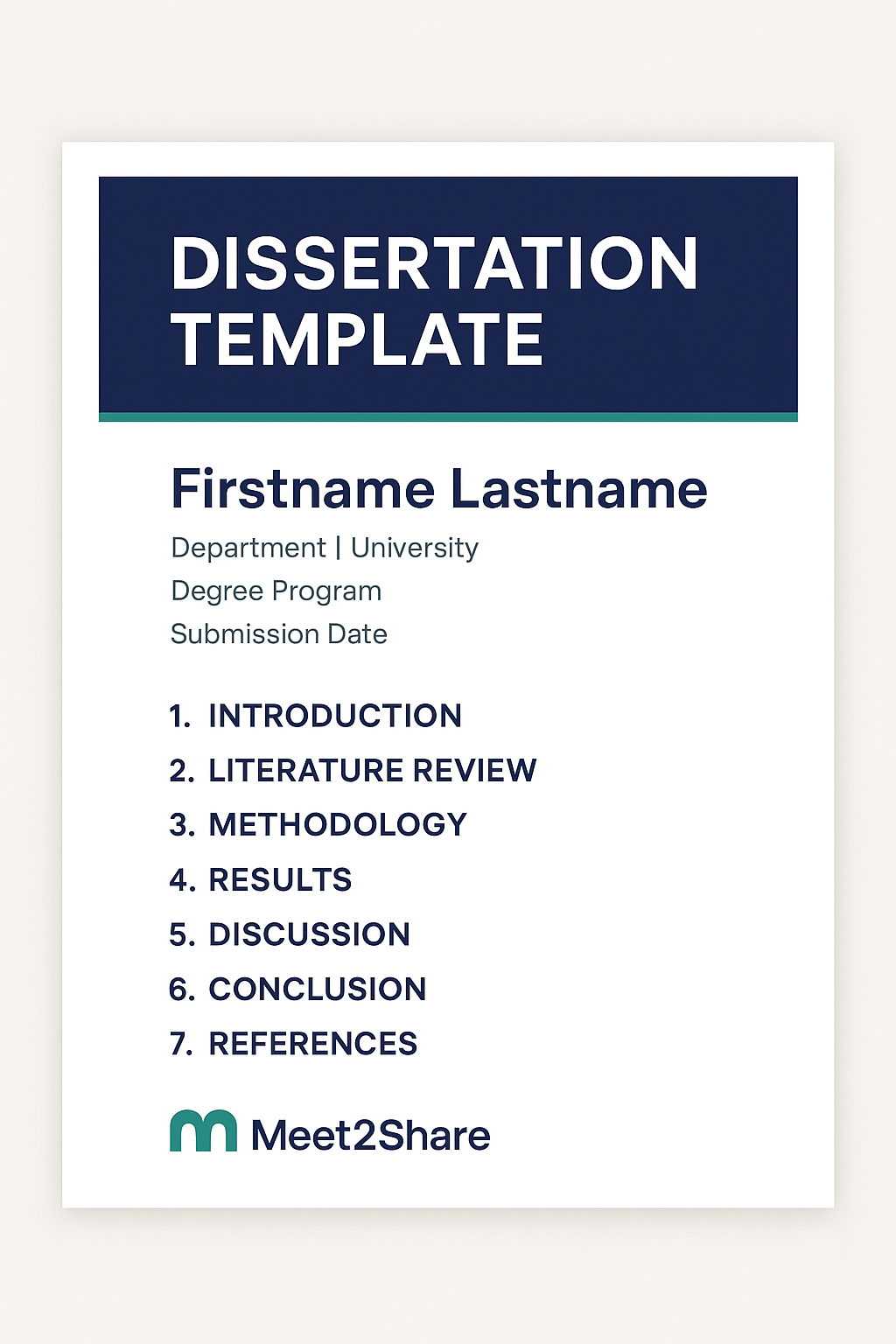
Dissertation Structure Template
The structure varies by field, but most dissertations include the following core sections:
- Title Page – Title, name, supervisor, institution, date
- Acknowledgements – Thank mentors, peers, family
- Abstract – 150–300 words (topic, method, key results, conclusion)
- Table of Contents – Chapters, subheadings, appendices
- List of Figures/Tables/Abbreviations/Glossary – Optional but helpful
- Introduction – Background, scope, objectives, questions
- Literature Review – Analyze existing research, identify gaps
- Theoretical Framework – Key theories and concepts guiding your study
- Methodology – Approach, data collection, analysis, justification
- Results – Report findings objectively
- Discussion – Interpret findings, implications, limitations
- Conclusion – Summarize contributions, suggest future research
- References – Consistent citation style
- Appendices – Surveys, transcripts, or extra material
📌 Pro Tip: Start building your dissertation with the free Meet2Share Dissertation Template (Word & PDF) → Download here.
How to Write a Literature Review
A strong literature review is the foundation of your dissertation. It should:
- Summarize and critique existing research
- Identify gaps, themes, and debates
- Justify your research’s contribution
👉 Need help evaluating sources? Join the Meet2Share Academic Exchange for peer feedback and curated resource lists.
Methodology: Choosing the Right Approach
Your methodology explains how you conducted your research. Include:
- Approach (quantitative, qualitative, or mixed)
- Data collection methods (interviews, surveys, experiments, etc.)
- Analysis techniques (statistics, discourse analysis, coding)
- Justification for your choices
💡 Share your methodology draft in the Questions Hub to get constructive feedback before committing.
Presenting Results & Discussion
- Results: State findings clearly (tables, graphs, statistics). Avoid interpretation here.
- Discussion: Analyze results, compare with literature, address limitations, explain unexpected outcomes.
👉 Many students practice their results defense by running trial Q&A sessions in the Meet2Share forum.
Dissertation Conclusion
The conclusion should:
- Restate your research question
- Summarize findings
- Highlight contributions
- Suggest directions for future research
End strong: make sure your work demonstrates why it matters.
Dissertation Examples
Here are three real-world dissertation titles for inspiration:
- Heat, Wildfire and Energy Demand: An Examination of Residential Buildings and Community Equity – C. A. Antonopoulos
- Exploring Income Volatility and Financial Health Among Middle-Income Households – M. Addo
- Mindfulness Meditation and Phantom Limb Pain in Amputees – N. S. Mills
For more examples and shared student insights, check the Meet2Share community.
✅ Dissertation Submission Checklist
Before you submit, make sure you’ve:
- ✅ Completed all sections (title page → appendices)
- ✅ Written a clear, concise abstract
- ✅ Structured a comprehensive literature review
- ✅ Justified your methodology
- ✅ Reported results objectively
- ✅ Interpreted findings in the discussion
- ✅ Written a conclusion answering your main research question
- ✅ Formatted references consistently
- ✅ Proofread thoroughly
👉 Need a second opinion? Upload your checklist in the Meet2Share Questions Hub and get peer review before submitting.
🎁 Free Dissertation Template
We’ve designed a Meet2Share-branded Dissertation Template (Word & PDF) with:
- ✅ Ready-made structure (all core sections included)
- ✅ Notes & prompts under each section
- ✅ Academic-friendly formatting
- ✅ Easy adaptation for your university requirements
👉 Download your Dissertation Template now
Final CTA
A dissertation is a journey—and you don’t have to take it alone. Join the Meet2Share community, where students and academics share resources, exchange drafts, and prepare for defenses together.
👉 Start now: Ask your first dissertation question here.
When Silence Hurts: Why Students Need Each Other More Than Ever
The Loneliest Sound in Academia

It’s 2:00 a.m. Your laptop screen glares back at you, the cursor blinking like a taunt. You’ve read the books, scoured journal articles, even brewed your third cup of coffee. Yet, the words just won’t come. The deadline creeps closer.
If this sounds familiar, you are not alone. Across campuses worldwide, millions of students face the same silent battles—overwhelmed, isolated, and under immense pressure to succeed.
The problem isn’t intelligence or effort. It’s that academia, for all its promise, often leaves students to fight their struggles alone. Institutions teach what to learn, but rarely how to survive the journey.
This silence is exactly what platforms like Meet2Share Questions are built to break. They turn lonely battles into shared journeys, replacing stress with solidarity and isolation with community.
The Hidden Reality Behind Academic Pressure
Universities often sell education as a path of growth, discovery, and endless opportunity. But behind the glossy brochures lies another truth: anxiety, exhaustion, and silent suffering.
- Global Crisis: According to the WHO (2022), over 35% of students report severe stress that can escalate into depression or burnout.
- Local Crisis: In Zimbabwe, ZIMCHE (2023) found dropout rates climbing—not only due to finances but also due to overwhelming academic stress.
- Silent Expectations: For many African households, education is a family investment. The unspoken demand to succeed makes every failed test feel like betrayal.
Have you ever hesitated to open an email from your lecturer, fearing bad news? Or told your parents “everything’s fine” when deep down you were drowning? You’re not alone. This is the silent struggle of modern students.
Beyond Numbers: The Human Cost
Academic pressure is not just about grades. It eats away at confidence, relationships, and mental health.
- Students sacrifice sleep, meals, and social lives just to keep up.
- Many measure their entire self-worth by GPA or thesis progress.
- One missed deadline feels like the end of a future.
This emotional toll explains why so many students—brilliant and hardworking—quietly give up, not because they lack ability, but because they lacked support.
The Zimbabwean Context: Struggles on Steroids
In Zimbabwe, academic pressure comes with unique challenges:
- Outdated libraries and unreliable internet.
- Overcrowded lecture halls, where individual mentorship is rare.
- Limited research support, especially for postgraduates.
As Chireshe (2020) notes, many Zimbabwean students extend or abandon studies not from lack of intelligence, but from lack of structured support.
And this is where peer-to-peer platforms like Meet2Share step in: filling the gaps institutions can’t cover, building bridges of solidarity where formal support falls short.
👉 Join the conversation now: Meet2Share Questions
The Comparison Trap
Beyond institutional challenges, there’s a new pressure: social media comparison culture.
On LinkedIn, it looks like everyone is publishing, winning scholarships, and landing jobs. Instagram makes peers appear effortlessly successful. But what we don’t see are their sleepless nights, failed drafts, or silent breakdowns.
This curated reality deepens student isolation. As UNESCO (2022) warns, modern education is no longer just about academics—it’s about surviving constant comparison in a hyperconnected world.
Peer communities help break that illusion, showing the truth: everyone struggles, and nobody succeeds alone.
Why Peer-Exchange Is the Game-Changer
Global research proves that students do better together:
- Harvard Education Review (2020): Peer-supported students retained 70% more knowledge than those working in isolation.
- Kenya (AVU, 2020): Peer learning groups boosted exam scores by 20%.
- Zimbabwe (UZ Study, 2023): Students active in WhatsApp study groups submitted assignments earlier and reported higher satisfaction.
But here’s the key difference: unlike informal chats, Meet2Share organizes peer exchange into a structured, supportive ecosystem, combining global reach with the intimacy of genuine student-to-student help.
👉 Ready to experience it? Start here: Meet2Share Questions
From Isolation to Belonging
The real power of peer exchange isn’t just academic—it’s emotional.
- It validates your struggle (“I’m not the only one stuck here”).
- It builds confidence (teaching peers reinforces your own mastery).
- It restores humanity to learning (“You are more than your grades”).
As neuropsychology shows, supportive connections release oxytocin, reducing stress hormones and boosting learning capacity. In other words, peer support literally rewires your brain for resilience.
Imagine posting your toughest question online—and instead of silence, you get answers, encouragement, and even study strategies from peers across the globe. That’s not just learning; that’s belonging.
A Call to Action: Reclaim Learning Together
Education was never meant to be endured alone. From African oral traditions of collective learning to today’s digital classrooms, knowledge has always thrived when shared.
Now it’s your turn to reclaim that tradition.
- If you’re overwhelmed, don’t suffer in silence.
- If you’re confident in a subject, don’t hoard it—share it.
- If you’re stuck, don’t quit—connect.
Because every time you post a question, answer one, or share a resource, you’re not just helping yourself. You’re building a global tribe of learners who rise together.
👉 Take the first step now: Join Meet2Share Questions
Final Word
Academic pressure thrives in silence. But silence ends the moment you choose to share.
Platforms like Meet2Share don’t just provide answers; they provide community, belonging, and resilience.
Your struggle does not define you. Your willingness to reach out does.
So ask. Share. Connect. Transform your academic journey today.
👉 Click here to begin: Meet2Share Questions
How Did I Find My Thesis Topic Idea?
(A Long Story of Struggle, Failure, Breakthrough, and Finding Help)

When people ask me how I found my thesis topic, they usually expect a short and neat answer—something like, “Oh, I was inspired by a lecture” or “My supervisor suggested it.” But the truth is far messier, and, I would argue, much more real. I didn’t just stumble upon a golden idea. I struggled. I doubted myself. I failed. And in that failure, I discovered something far more valuable than I had originally been looking for.
I began my graduate studies with one pressing worry: What on earth am I going to write about? Choosing a thesis topic is one of the most daunting parts of academic life. It feels like trying to decide on a single word to summarize years of your intellectual curiosity. Everyone around me seemed more certain. My peers talked confidently about cutting-edge machine learning applications, quantum-inspired algorithms, or elegant theorems they wanted to extend. I, on the other hand, felt stuck in a fog.
I wanted a problem that was simple enough to be approachable yet deep enough to be meaningful. That balance is so hard to strike. If you pick a trivial question, it won’t impress anyone. If you pick an impossibly ambitious one, you’ll drown in frustration. And so I kept searching, hoping that somewhere between simplicity and depth, I would find my home.
My initial attempts at brainstorming felt mechanical. I wrote down lists of areas I liked: computational geometry, combinatorics, algorithms. Then I scanned through textbooks and research papers, jotting down open questions. Still, nothing seemed to resonate. It felt like borrowing someone else’s problem, not finding my own.
One evening, while flipping through a collection of geometry problems, I came across something that seemed deceptively simple:
Given a set of n points in the plane, do any three of them lie on a common line?
At first glance, it seemed trivial. You could just check every triple of points, right? That’s an O(n3)O(n^3)O(n3) algorithm—brute force, but correct. But the more I thought about it, the more I wondered: could we do better? Was there a cleverer, faster method hiding beneath the surface?
That question lit a spark. Unlike many other problems I had skimmed past, this one hooked me. It felt approachable yet deep. It was the kind of problem you could explain to your grandmother in one sentence, but solving it could keep a researcher awake at night. That was the sweet spot I had been searching for.
So, I made it my mission: I would find a faster algorithm. I believed that if I could improve upon the obvious O(n3)O(n^3)O(n3) approach, even modestly, it would be a valuable contribution to computational geometry.
The first weeks were filled with excitement. I tried sorting points, using sweepline techniques, adapting divide-and-conquer strategies. I studied how collinearity checks worked in other contexts, such as computational graphics and computer vision. Each idea seemed promising at first, only to collapse under the weight of complexity.
Still, I pressed on. Failure, after all, is part of research. I thought: Surely I’ll find the trick if I just keep digging.
But as weeks turned into months, my optimism began to waver. Every attempt ended in the same frustration: no matter how I sliced it, I couldn’t beat the brute-force bound in any significant way. I began to wonder if the problem was not with my methods, but with the problem itself.
That’s when the breakthrough happened—not in the form of a faster algorithm, but in the realization that a faster algorithm might not exist at all.
I shifted perspective. Instead of asking, “How do I solve this faster?” I asked, “Is it even possible to solve this faster?” That subtle shift changed everything. I dove into lower bounds, computational models, and impossibility proofs. I discovered that under a restricted but natural definition of “algorithm,” one could actually prove that no faster algorithm exists.
This was not what I had set out to do. I had hoped to write about efficiency, clever data structures, and speed-ups. Instead, I ended up proving limits. Yet, in a strange way, that was more satisfying.
Because here’s the thing: research is not about confirming your expectations. It’s about following the truth where it leads, even if that truth is inconvenient.
At first, I felt like a failure. I had promised myself a faster algorithm, and I had none to show for it. But my supervisor reassured me: proving impossibility is just as valuable as proving possibility. By showing that no faster algorithm exists (within the model), I had answered the question just as definitively as if I had found a shortcut.
That realization was a turning point for me—not just academically, but personally. I learned that sometimes the failed path is the real path. Sometimes, in trying to solve a problem one way, you uncover a deeper truth that you never expected.
And that, in essence, is how I found my thesis topic. It wasn’t neat, it wasn’t planned, and it wasn’t what I thought I wanted. But it was mine.
Now, if my story ended here, it might sound too tidy. So let me pause to acknowledge the mess: finding a thesis topic was not a one-time eureka moment. It was months of stress, self-doubt, and late nights. It was watching my peers seemingly soar ahead while I felt stuck. It was asking myself over and over: Am I good enough for this? Do I even belong here?
That emotional weight is something we don’t talk about enough in academia. We talk about results, publications, contributions. But beneath the polished surface, every student carries a storm of insecurities. Choosing a thesis topic is not just an intellectual decision; it’s an emotional battleground.
And it’s exactly in those moments of doubt that I realized the importance of community, of having people to share the struggle with, and of having platforms where guidance is available.
Back then, I didn’t know about spaces like meet2share.com. I wish I had. Because the hardest part wasn’t the mathematics—it was the loneliness. It was sitting with questions that felt too “basic” to ask my supervisor, too “silly” to bother my peers with.
Platforms like meet2share.com/questions/ are, in many ways, lifelines. They create the kind of academic community I longed for—one where you can ask the “stupid” questions without judgment, share the weight of your confusion, and discover that you’re not the only one struggling.
Imagine how much easier my journey would have been if I could have connected with other students wrestling with similar challenges, if I had affordable, reliable help within reach. Instead of drowning in solitude, I could have shared the burden, found clarity faster, and maybe even saved months of frustration.
Because here’s a truth that every graduate student needs to hear: you don’t have to do this alone. Academia sometimes sells the myth of the lone genius—the brilliant mind who retreats into isolation and emerges with a masterpiece. But in reality, research is a collective endeavor. Ideas flourish when shared, refined, and tested in conversation.
That’s why communities matter. And that’s why, when students today ask me how to find their thesis topic, I don’t just tell them to read papers or brainstorm problems. I tell them to connect. Ask questions. Share half-baked ideas. Because the spark you’re looking for might just come from a conversation.
And yes, sometimes that conversation happens with your supervisor. Sometimes it happens with a peer. And sometimes, it happens on platforms built exactly for that purpose—like meet2share.com, which has quickly become one of the best online spaces for academic Q&A.
Of course, online platforms aren’t the only resource. During my search, I leaned heavily on digital tools:
- Google Scholar, for scanning related research.
- ResearchGate, for connecting with scholars working on similar problems.
- Academia.edu, for discovering unpublished drafts and ongoing work.
- JSTOR, for deep dives into classical papers that gave me historical perspective.
Each of these had their place. But what was missing was the personal touch—the human side of research. I could read papers all day, but I needed someone to tell me: “Hey, it’s normal to feel stuck. I’ve been there too.”
That’s where platforms like meet2share.com fill a unique gap. They blend the academic and the emotional, the intellectual and the personal. They remind you that behind every paper, there’s a human who once felt just as lost as you do now.
Looking back, my thesis journey was not just about algorithms and proofs. It was about learning resilience, patience, and the power of reframing failure.
I started by chasing speed. I ended by proving limits. And in that pivot, I discovered my true contribution.
For anyone reading this who is still searching for their thesis topic, let me say this: don’t panic if you don’t have a crystal-clear idea right away. Most of us don’t. Start with curiosity. Follow the problems that nag at you. And don’t be afraid to “fail” your way into a new direction. Sometimes failure is the doorway to discovery.
And remember, you don’t have to walk that path alone. Communities like meet2share.com and meet2share.com/questions/ exist for exactly this reason: to remind you that your struggle is shared, and that help is never more than a click away.
One of the hardest truths I had to accept during my thesis journey is that there is no such thing as a “perfect topic.” For months, I searched as if there was a holy grail problem waiting for me, something that would be both groundbreaking and easy enough to tackle within the limits of my program. But perfection is an illusion.
Most topics evolve. They begin small, rough, and sometimes clumsy. Over time, as you work, refine, and rethink, they grow into something more substantial. The story I told earlier—how I shifted from searching for a faster algorithm to proving impossibility—is a perfect example of this evolution. I didn’t start with the final destination in mind. I stumbled my way into it.
That is the truth about thesis topics: they are discovered, not chosen. They grow out of failure, curiosity, and persistence.
But while the intellectual part of that journey is important, the emotional part is just as real—and often more difficult. Every day, I watched my peers talk about their clear, polished ideas. I sat in seminars where students gave confident presentations about their well-defined projects. And I sat there with my messy, uncertain problem, wondering if I was falling behind.
This is where imposter syndrome creeps in. It whispers: “You don’t belong here. You’re not smart enough. Everyone else has it figured out except you.”
If you’re reading this and nodding, know that you’re not alone. Imposter syndrome is almost universal in academia. But it thrives in silence. The more we keep it hidden, the more powerful it becomes. That’s why I now believe so strongly in academic communities—not just for sharing knowledge, but for sharing struggles.
The mistake I made early on was thinking that asking for help was a weakness. I thought: If I ask too many questions, people will think I’m not smart enough. So I kept quiet. I struggled alone.
But silence makes the journey longer and lonelier. Imagine how much easier my life would have been if I had felt safe to ask: “Why does this approach fail? Has anyone else tried something like this?” That’s why platforms like meet2share.com/questions/ feel revolutionary to me now. They create exactly the kind of safe space I needed—somewhere to ask without fear of judgment, somewhere to get guidance without shame.
When you share your struggle, two things happen: you realize you’re not alone, and you open the door for solutions you wouldn’t have found on your own. That’s the power of academic community.
Beyond imposter syndrome, there’s another emotional challenge: the fear of wasting time. Every time I chased an idea that failed, I thought: I’ve wasted weeks. I’m falling behind.
But research doesn’t work like that. Every failed attempt adds to your understanding, even if it doesn’t feel like it at the time. Failure is not wasted effort—it’s raw material for discovery.
In my case, all the failed attempts to find a faster algorithm eventually prepared me for the shift in perspective. I couldn’t have proven impossibility without first exhausting all the possible “faster” paths. Failure wasn’t wasted; it was essential.
So if you’re reading this while feeling stuck, take a breath. Your failures are not empty—they are shaping the path you cannot yet see.
Of course, telling yourself this in the moment is hard. That’s why emotional support is so crucial. A friend once told me, “The most important resource in grad school is not your library, but your people.” I didn’t believe it at first. But over time, I learned it was true.
Your people are the ones who remind you that you’re not failing alone. They help you zoom out when you’re drowning in details. They celebrate the small victories that academia often overlooks.
This is why I admire spaces like meet2share.com. They don’t just offer academic help—they create community. And sometimes, community is the difference between quitting and persevering.
Let me share another story. A close friend of mine in graduate school started with an ambitious plan: she wanted to design a new machine learning framework for healthcare applications. Six months in, the project collapsed—data access issues, ethical approval hurdles, technical complexity. She felt like a complete failure.
But in talking with others, she realized there was a more approachable question: instead of creating a new framework, she could evaluate how existing models performed on limited datasets. It wasn’t as glamorous, but it was achievable—and valuable.
Today, her work is widely cited because it addressed a real-world gap. She didn’t end up where she started, but she ended up somewhere important.
This is a lesson worth repeating: your thesis does not have to be the most groundbreaking idea in the world. It has to be yours—authentic, meaningful, and achievable.
The practical question, of course, is: How do you actually find that kind of topic?
Here’s what worked for me, and what I now recommend to others:
- Start with curiosity. Don’t worry yet about novelty or impressiveness. Ask: What problems genuinely interest me?
- Read widely. Use Google Scholar to trace citations and see how problems evolve. Sometimes the most interesting questions hide in the “future work” sections of papers.
- Talk to people. Share your half-baked ideas. Post them on platforms like meet2share.com/questions/. Sometimes, a casual comment from someone else will shift your perspective entirely.
- Embrace small beginnings. A simple question, pursued deeply, can be more valuable than an overly ambitious one you can’t complete.
These steps don’t guarantee clarity overnight, but they create the conditions where clarity can grow.
Another tip that saved me: journal your process.
During my search, I kept a notebook where I wrote down every idea, no matter how silly it seemed. At first, I thought it was pointless. But months later, I noticed patterns—questions that kept reappearing, problems that continued to nag at me. That was a clue.
Your best thesis topic might not arrive as a thunderbolt of inspiration. It might be the problem that quietly refuses to leave you alone. Journaling helps you see those patterns.
And again, sharing those notes with others—whether friends, supervisors, or an academic community like meet2share.com—can help you recognize which ideas have potential.
It’s also important to remember that thesis topics don’t exist in a vacuum. They are shaped by context: available resources, time constraints, and personal circumstances.
For me, proving impossibility worked because I had access to the right background and tools in computational geometry. For my friend, shifting to model evaluation worked because it matched the resources she could realistically access.
So ask yourself: What do I have access to? What skills do I already bring? What limitations do I face? Your best topic will fit at the intersection of curiosity and feasibility.
And when you’re unsure, reach out for advice. Communities like meet2share.com/questions/ are excellent for this. Sometimes, someone else can see the feasibility issues more clearly than you can.
Let’s talk about another emotional trap: comparison.
In academia, it’s almost impossible not to compare yourself to others. You see your peers publishing, presenting, or confidently stating their topics, and you feel like you’re falling behind. I certainly did.
But comparison is dangerous because everyone’s journey is different. The friend who finished early might have had a clearer project from the start. The peer who published quickly might have been working on a supervisor’s idea rather than finding their own. You don’t see the full picture, only the polished surface.
Your journey is yours. It doesn’t have to match anyone else’s timeline.
If anything, my “late” discovery of my true topic was a blessing in disguise. It gave me time to mature intellectually, to make mistakes, and to learn resilience. In the end, I was proud of my work precisely because it was hard-won.
So if you’re reading this and feeling behind, take heart. Sometimes being “behind” is what forces you to dig deeper, to find an idea that’s truly your own.
And if you need encouragement along the way, remember there are places designed to lift you up. meet2share.com is one of them—a reminder that even in the lonely corridors of academia, you don’t have to walk alone.
Now, let me circle back to resources. Beyond meet2share.com, here are some other platforms that I found invaluable:
- ResearchGate: not just for papers, but for connecting with authors directly. Don’t be afraid to message researchers with questions—you’ll be surprised how many respond kindly.
- Academia.edu: a treasure trove of unpublished drafts and ongoing projects.
- JSTOR: perfect for grounding your work in historical context. Sometimes the “old” papers spark new ideas.
Use these alongside community-driven platforms like meet2share.com/questions/, and you’ll have both knowledge and connection—the two pillars of successful research.
By this point, you might be wondering: So was your thesis a success?
In the traditional sense, yes. I defended, passed, and published. But more importantly, it changed me. I learned that research is not about proving your brilliance. It’s about following curiosity, enduring uncertainty, and discovering truth—even when that truth is not what you expected.
And that’s what I want every struggling student to hear: your worth is not tied to the elegance of your thesis topic. It’s tied to your persistence, your openness, and your willingness to learn.
So, how do you find your thesis topic?
- You start messy.
- You embrace failure.
- You lean on others.
- You follow curiosity, not perfection.
And when you feel lost, you remember that resources exist to guide you—whether it’s digital libraries for knowledge, or communities like meet2share.com for connection.
My story is just one version of this journey. Yours will look different. But I promise: if you keep searching, keep failing, and keep reaching out, you will find your topic.
When I look back now, I don’t just see theorems and algorithms. I see late nights filled with doubt. I see pages of failed attempts. I see conversations that gave me hope when I wanted to quit. And I see the strange beauty of failure turning into contribution.
So if you’re searching for your thesis topic right now, take heart. It’s okay to feel lost. It’s okay to change direction. It’s okay to fail. That’s not a sign you don’t belong—it’s the very process of belonging.
And remember: you don’t have to do it alone. There are communities, lifelines, and platforms built exactly to help students like you. For me, discovering meet2share.com later in my journey felt like finding the supportive community I had always needed. For you, it might just be the starting point that changes everything.
Because in the end, the real thesis is not just the paper you submit. It’s the person you become along the way.
What It’s Really Like Writing a PhD Dissertation: The Emotional, Exhausting, and Life-Changing Journey
Writing a PhD dissertation is one of the hardest journeys in academic life. This guide explores the emotional highs and lows, practical strategies, and how Meet2Share.com/questions can be the lifeline every PhD student needs.
“The Day You Say ‘I’m Doing a PhD’ Feels Like You’ve Just Jumped Off a Cliff”
Deciding to pursue a PhD is exhilarating — and terrifying. The moment you announce it, friends smile, family nods politely, but inside, a storm brews. You’re thrilled at the idea of research, discovery, and contributing to knowledge. But deep down, a tiny voice whispers, “Do you really know what you’re getting into?”
PhD dreams are enormous. They are built on a promise: years of work, intellectual growth, and personal transformation. But the path is paved with isolation, doubt, and emotional hurdles that nobody warns you about.
It’s here that platforms like Meet2Share.com/questions become invaluable. This is not just a forum — it’s a lifeline. For thousands of PhD students, Meet2Share has become the platform that saved me — and can save you too, offering a place to ask questions, vent frustrations, and find reassurance when hope seems thin.
“Why Writing a PhD Feels Like Living on an Island”
The loneliness of dissertation writing is legendary. Unlike other academic work, a PhD isolates you. Friends move on with careers, family doesn’t always understand, and you spend hours staring at a screen, questioning every decision.
Weeks can pass without meaningful social interaction. Impostor syndrome creeps in, convincing you that everyone else is excelling while you flounder. That sense of isolation can paralyze motivation.
But connecting online with peers makes a difference. Platforms like Meet2Share.com/questions create virtual islands where PhD students are never truly alone. Here, you see others asking the same questions you’re too afraid to voice:
- “Am I the only one who’s completely stuck?”
- “How do I manage my data without losing my mind?”
- “Does anyone else feel like quitting every week?”
Seeing these questions answered — often with empathy and practical advice — is a reminder: you are not failing. You are human, and your struggles are shared.
“Why Writing a PhD Feels Like Running a Marathon You Never Trained For”
A dissertation isn’t a sprint — it’s a marathon, and many PhD students start without a training plan. Early stages are filled with boundless reading, endless note-taking, and the constant worry: Am I doing enough?
The middle stage demands data collection, experimentation, and writing drafts that often feel meaningless. The final stage is a blur of edits, rewrites, and late nights that test every ounce of stamina.
Time management is essential. Tools like the Pomodoro Technique help break writing into manageable intervals. Reference managers like Zotero save sanity when citations pile up. And platforms like Grammarly provide the safety net to catch the small but critical errors that derail clarity.
Yet, even the best tools can’t replace human connection. That’s where Meet2Share becomes vital. Sharing progress, asking for tips, and even posting a “small win” keeps motivation alive. Here, the marathon feels less solitary and more like a group run.
“From Tears to Triumph: The Emotional Rollercoaster No One Warns You About”
PhD life is a relentless mix of highs and lows. One day, you crack a theory and feel invincible. The next, a single piece of critical feedback makes you question everything.
Mental health is fragile during this journey. Many students experience anxiety, depression, or persistent stress. PhD Balance and the Mental Health Foundation provide resources, but the emotional validation from peers is priceless.
When you post a question or vent on Meet2Share, you often discover countless others have felt the same way. It transforms despair into understanding. Suddenly, the lows feel bearable, and the highs feel shared. You’re not just surviving; you’re connecting.
“Why Drafting Your Dissertation Feels Like a Never-Ending Rewrite”
No dissertation is perfect on the first try. Chapters are rewritten multiple times, data is reanalyzed, and citations are double-checked until your eyes hurt.
Feedback from supervisors can sting, but it’s necessary. Comments like “needs clarity” or “expand this section” often feel personal, yet they push you to refine your work. The truth: writing is rewriting.
Sharing your struggles online is empowering. Uploading drafts to Meet2Share.com/questions or asking peers for feedback provides a fresh perspective and a morale boost. Even a simple comment like “I’ve been there — you’re doing great” can reignite your motivation.
“The Lifeline You Didn’t Know You Needed”
Many students underestimate the importance of peer support. Academic advice is critical, yes, but emotional and practical guidance from fellow PhD students is priceless.
Meet2Share offers exactly that. It’s a space to:
- Vent frustrations without judgment.
- Seek advice on writing, research, and productivity.
- Celebrate small victories, like finishing a chapter or mastering a tricky concept.
It becomes the platform that not only saves your dissertation progress but also your sanity. Thousands of students credit it as the reason they didn’t give up when deadlines loomed and burnout threatened.
“The Breakthroughs That Make It All Worthwhile”
Every dissertation has turning points — moments when confusion gives way to clarity. A pattern emerges, an argument clicks, or a chapter finally makes sense.
These breakthroughs are deeply personal but often shared in online communities. A student’s post on Meet2Share celebrating a “finally finished chapter” can inspire dozens more to keep going. It’s a reminder: progress is real, and even small wins matter.
“The Final Stretch: Why the End Feels Stranger Than the Beginning”
The last months of dissertation writing are surreal. Relief mixes with anxiety. Editing becomes obsessive. Every word feels weighty, every citation critical.
Time-tested strategies can help. Use resources like the Thesis Whisperer for writing tips, Oxford Student Advice for structuring chapters, and Harvard GSAS tips for dissertation defense prep.
But the emotional support from peers is unmatched. Sharing frustrations or countdowns on Meet2Share creates a virtual cheer squad. Every post, every comment, is a reminder that you are not alone.
“Who You Become After the Dissertation”
Finishing a dissertation transforms you. You gain resilience, independence, and critical thinking. You learn to survive extreme stress and come out stronger.
The process teaches humility — perfection is impossible, but progress is real. It fosters empathy, patience, and problem-solving skills that extend far beyond academia.
And the shared experience of writing with a community — with platforms like Meet2Share.com/questions — creates lasting bonds and a sense of belonging you might never have expected.
“Why No One Should Walk This Road Alone”
The myth of the lone scholar is harmful. Independence does not mean isolation. Every PhD student benefits from networks, peer guidance, and support systems.
This is the moment where Meet2Share becomes essential. It is not just a platform — it is the lifeline that ensures students don’t crumble under pressure. By sharing your experiences, asking questions, and celebrating victories together, the platform proves that the PhD journey, no matter how lonely it feels, is never truly solitary.
“The Platform That Saved Me — And Can Save You Too”
Throughout the PhD journey, there is a recurring lesson: human connection matters as much as intellect.
Meet2Share.com/questions is bold, unashamed, and essential. It offers:
- Peer validation.
- Advice from students who have faced the same hurdles.
- Emotional support during the darkest dissertation nights.
- A place to share wins and setbacks alike.
Thousands of students testify that engaging with Meet2Share was the turning point in completing their dissertations. For those struggling with motivation, isolation, or self-doubt, this platform isn’t optional — it is transformative.
Share it. Post your questions. Celebrate your small victories. Because the next student who finds hope in your post might just finish their dissertation too.
Conclusion: The Truth About Writing a PhD Dissertation
Writing a dissertation is exhausting, isolating, and overwhelming — but it is also profoundly rewarding.
It is a journey that tests intellect, character, and endurance. It’s a story of resilience, emotional growth, and eventual triumph.
And it is a journey you don’t have to take alone. Platforms like Meet2Share.com/questions prove that connection is the missing piece, the difference between giving up and crossing the finish line.
If you know someone struggling with their dissertation, share this platform. You could be giving them not just advice, but hope.
Because hope, in the world of PhD dissertations, is often the difference between quitting and finishing.