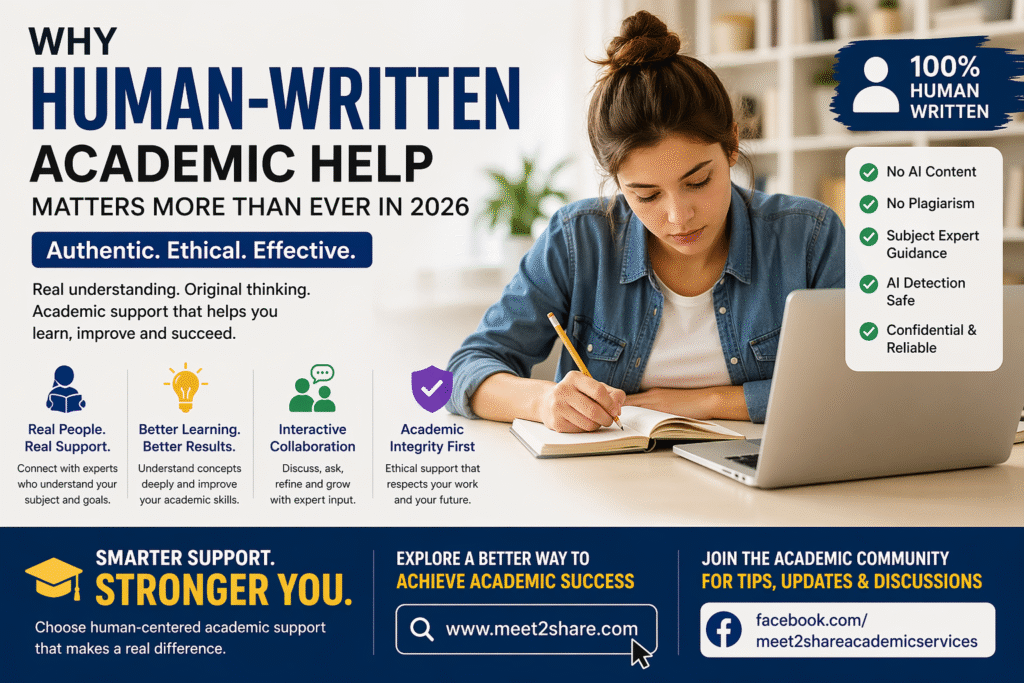
Why “Human-Written” Academic Help Matters More Than Ever in 2026
If you’ve been searching for academic writing help lately, you’ve probably noticed something frustrating:
Everything claims to be human-written…
But much of it still feels generic, scripted, or just slightly “off.”
That gap between promise and reality is exactly why more students in 2026 are rethinking how they get academic support.
🤖 The Problem with AI-Like Writing (Even When It’s Not AI)
AI tools have changed the academic space—but not always for the better.
Students now face:
- Writing that sounds polished but lacks real depth
- Arguments that feel repetitive across different papers
- Work that doesn’t reflect their personal academic voice
Institutions are also adapting. Systems influenced by platforms like Turnitin are becoming more sensitive to patterns that signal non-authentic writing.
So the real question students are asking today is:
👉 “How do I get help that actually sounds like me—and still meets academic standards?”
🎯 What “Human-Written” Should Actually Mean
In 2026, human-written academic help isn’t just about avoiding AI tools.
It’s about:
- Real understanding of your subject
- Writing that matches your level and tone
- The ability to ask questions and refine ideas
In short:
👉 It’s not just about getting work done
👉 It’s about being part of the process
🧠 The Shift: From Outsourcing to Collaboration
A growing number of students are quietly moving away from traditional writing services.
Instead of:
❌ Submitting instructions and waiting for a finished paper
They’re choosing:
✅ Interactive, human-centered support
This allows them to:
- Improve their arguments
- Understand their assignments better
- Produce more authentic work
🌐 A Smarter Way to Approach Academic Help
Rather than relying on one-way services, some students are exploring collaborative academic environments—spaces designed for interaction, not just delivery.
These platforms allow you to:
- Engage with ideas before final submission
- Get feedback that actually improves your thinking
- Develop work that reflects your own voice
If you want to see how this kind of approach works in practice, you can take a closer look here:
👉 https://meet2share.com/
It’s not positioned as a typical “writing service”—and that’s exactly the point. The focus is on supporting your academic process, not replacing it.
💬 Why Academic Communities Are Becoming Essential
Another major shift is happening outside traditional websites.
Students are increasingly relying on peer-driven spaces for:
- Honest advice
- Real academic experiences
- Practical guidance
These conversations often provide more clarity than static service pages.
You can see an example of this kind of ongoing academic discussion and support here:
👉 https://www.facebook.com/meet2shareacademicservices/
These spaces offer something most services don’t:
👉 Real interaction and shared learning
📌 What to Look for Before You Choose Academic Help
Before you commit to any platform or service, ask yourself:
- Does this feel genuinely human?
- Can I interact and ask questions?
- Will this help me improve—not just submit?
- Does it adapt to my subject and level?
If the answer is no, you’re likely dealing with surface-level support.
🚀 Final Thought
In 2026, the difference isn’t just between good and bad academic writing services.
It’s between:
👉 Artificial support
and
👉 Authentic academic growth
Students who are getting the best results aren’t just outsourcing their work.
They’re choosing smarter, more human approaches—ones that help them think better, write better, and actually understand what they’re submitting.
And in the long run, that’s what truly sets them apart.